Europe deploys an unprecedented arsenal of financing measures
Europe is deploying an unprecedented arsenal of European funding to transform digital healthcare. But few startups know about them.
Between June 2025 and September 2026: 553.5 million euros. 23 calls for projects identified. Key dates to look forward to.
Whether you’re a start-up, SME or an innovative player in the sector, understanding these opportunities is essential to position your project at the heart of this revolution.
The problem? Most entrepreneurs discover this financing too late.
European budget and strategic priorities
For 2025-2026, the EU has allocated 553.5 million euros to two main areas:
- 333,5 M€: Developing innovative solutions to diseases
- 220 M€: Designing digital tools that transform healthcare
This funding is targeted at projects that combine three elements:
- Technological innovation (AI, data, interoperability)
- Concrete patient impact (measurable, clinically validated)
- Cross-border collaborative dimension (EU + non-EU countries)
Translation: If your project covers all three axes, you’re on target.
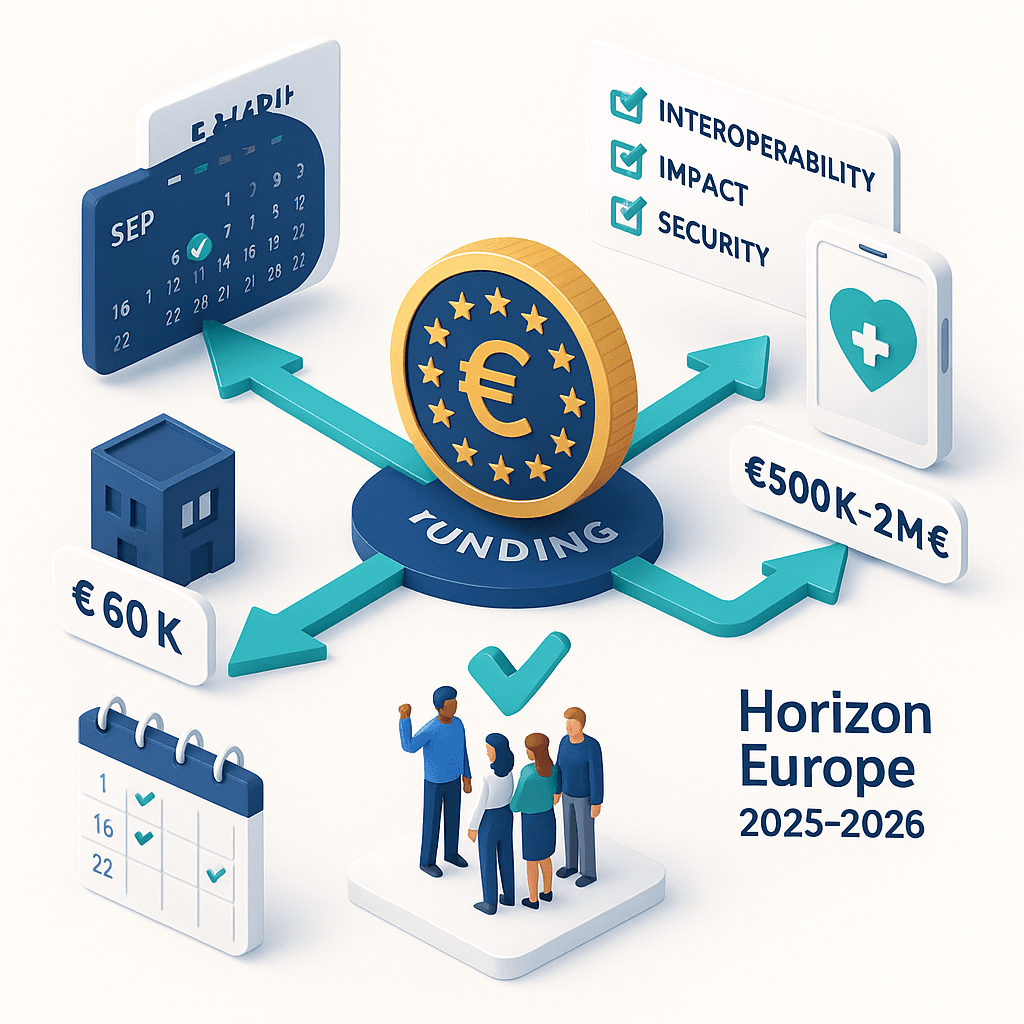
Critical calendar: key dates not to be missed
23 calls for projects identified, with the majority closing on September 16, 2025.
Be careful , as some of them close long before that.
Key dates to remember:
- May 22, 2025: Webinar “Info Day Cluster 1 Health” (register now)
- June-August 2025: Regular call windows (2-3 per month)
- September 16, 2025: Majority of calls closed
- September-November 2025: Final specialized calls (cybersecurity, sovereignty, etc.)
Anticipation = key to success. The best applications start 2-3 months before the closing date.
4 criteria the EU is really looking for
The European Commission favours projects that :
1. Integrate solution interoperability
What this means: Your tool is integrated into the existing IS, not isolated in a silo.
Why it matters: 80% of digital hospital projects fail due to lack of interoperability. The EU understands this.
How to prove : Standards FHIRstandards, REST API, existing IS connectors.
2. Have a real impact on care pathways
What it means: Not just “AI is cool”. Measurable: time, costs, patient outcomes.
Valid example: “Reduce diagnosis time by 30%, save €50K/year per facility”.
Invalid example: “Innovative AI solution to improve care”.
3. Respect sustainability and inclusiveness
Sustainability: Viable post-funding economic model. Not dependent on endless subsidies.
Inclusivity: Impact on vulnerable populations, team diversity, equitable access.
4. Demonstrate responsible innovation
It means: Ethics, AI governance, compliance RGPDrepresentative data (no bias).
Bonus: Formalized ethics committee, cybersecurity audit, HDS certification.
Rapid financing for prototyping (€60K)
For solutions to test quickly before aiming big:
Cascading grants of up to €60,000 are available. Relatively easy access.
Usage: Prototype, validate with users, adjust before targeting major calls (500K-2M€).
Timeline: 6-9 months project. Perfect for POC.
Minimum criteria :
- Team of 2-3 minimum (no solo founders)
- Academic partner or healthcare establishment
- Justified and detailed budget
- Clear, measurable deliverables
The 3 mistakes that kill job applications
Error 1: Generic application
“Our revolutionary AI is transforming healthcare.”
→ Immediate rejection. Be specific.
Error 2: No measurable impact
“Improves the caregiver experience.”
→ Wave. Dis “Reduces data entry time by 40%, saves €15K/year”.
Mistake 3: Neglecting interoperability
“We’re going to develop our own architecture.”
→ Reason for rejection number 1. Uses FHIR + existing connectors.
Recommended strategy: 3 steps
Stage 1: Opportunity audit (month 1)
- Identify 3-4 calls aligned with your project
- Check eligibility (team size, budget, timeline)
- Prepare letters of interest to potential partners
Stage 2: Structuring the application (months 2-3)
- Writing patient impact (data + customer cases)
- Document interoperability (architecture + standards)
- Prepare a detailed, realistic budget
Step 3: Submit and rotate (month 4+)
- Submit 2-3 applications at the same time (diversify risk)
- Prepare alternative versions if rejects
- Start with an execution phase while applications are being evaluated
To find out more
Do you have an e-health project to finance?
Let’s talk about your context. Identify suitable calls, build a bidding strategy, optimize chances of success.
Audit + recommendations: 30 minutes.
🎯 Going further
Are you structuring a MedTech fundraiser?
Download our free strategic reports:
- ✓ BPI France 50-point compliance checklist
- ✓ Timeline 0-6 months pre-emergence
- ✓ 3 startup cases (seed → series A)
- ✓ Frameworks valorisation multiples Revenue
📥 Download your free reports → Blueprint MedTec
About the author
Nicolas Schneider is a strategic advisor in digital healthcare transformation and founder of JuliaShift. With 17 years’ experience at the French Army Health Service and 8 years in digital transformation consulting, he assists MedTech startups and healthcare establishments in their financing strategy, structuring pharma partnerships and preparing for fund-raising.
Specialties: healthcare innovation financing, MedTech fund-raising structuring, pharma industrial partnerships, IA regulatory compliance.

Nicolas Schneider
https://juliashift.euFondateur de JuliaShift, spécialisé en transformation numérique en santé.

