Why 80% of hospital projects fail
Between 60% and 80% of digital hospital projects fail. But not for the reasons we think.
It’s never a technology problem. The real culprit? The organization. The players. The actual flows. Governance.
In other words: everything you forget to structure before clicking on “start project”.
Meanwhile, management is piling up digital tools. Like bricks without an architect’s plan. The result? Fragmented hospitals. Data remains in silos. And caregivers waste time reconciling incompatible systems.
That’s when everything changes.
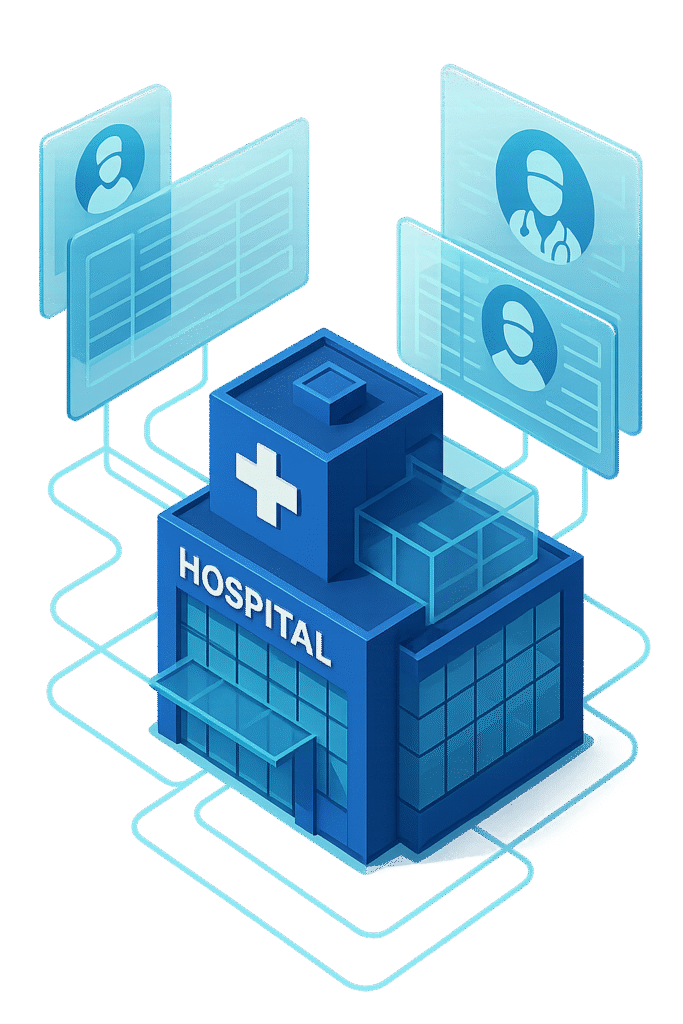
The hidden problem: fragmentation without vision
Many healthcare establishments have inherited a chaotic situation. Several generations of information systems coexist. Moreover, databases don’t talk to each other very well. Some departments still use paper. And nobody dares say: “We have to start from scratch.”
Why does this fragmentation persist?
Simply because digital transformation in healthcare is not a matter of IT budgets. Rather, it requires a profound reorganization. Consistent. Controlled.
Continuing to patch the existing system without an overall vision adds to the burden. It multiplies friction. And directly undermines the quality of care.
By 2050, one in five people will be over 60. With a healthcare system already under strain, ignoring this emergency means choosing collapse.
The solution: ZiRA, architecture designed for hospitals
In the Netherlands, someone asked a good question: “What if we designed a reference architecture… with hospitals?”
And so ZiRA (Ziekenhuis Referentie Architectuur) was born. Designed by Nictizthe Dutch center for electronic health information exchange, it is not a rigid model. On the contrary: it’s a collection of evolving models.
Unlike purely technological approaches, ZiRA starts from the ground up. It looks at how hospitals really work. Only then does it propose a structure.
What it brings together:
- Organization: structures, roles, responsibilities
- Processes: care flows, decision-making chains, interactions
- Information: data models, exchange standards
- Services: applications, tools, infrastructure
It’s this alignment that changes everything. Not technology. The alignment.
ZiRA + FHIR: strategy meets technology
Now we add a second layer. The one that makes everything concrete.
FHIR (Fast Healthcare Interoperability Resources) is an international standard. It structures health data. It uses modern web technologies: REST, JSON, and open APIs.
Where’s the magic?
On the one hand, ZiRA organizes your facility. On the other, FHIR makes data flow frictionlessly. The result: you get three major benefits:
- A clearer overview of your architecture
- The technical ability to exchange data securely
- Independence from proprietary publishers
And bonus: you already comply with future European requirements (in particular the EEDS regulation).
Three hospitals that dared to change
First, the Erasmus Medical Center in Rotterdam. It used ZiRA as the basis for its enterprise repository. Objective: map the existing organization, project the target organization, manage future transformations.
This is typically the role of a structured structured hospital PMO to manage without improvising.
Result: greater organizational efficiency and data consistency.
Then there was the Karolinska Institute in Stockholm. It applied the same approach. ZiRA was used to build a capacity model. This model anticipated needs on a county-wide scale. Here again, the approach went beyond pure technology. Instead, it was about structuring resources. The flows. Interactions.
This alignment between technology and organization is at the heart of any successful successful digital transformation.
Result: better strategic planning, optimized resource allocation.
Finally, the Antoni van Leeuwenhoek Hospital in Amsterdam. This is a reference center for cancerology. It used ZiRA to optimize its logistics. More specifically, patient care. ZiRA modeled the processes. Right down to the granular level of field tasks.
Result: improved patient flow and reduced processing times.
What hospitals really earn
By facilitating the flow of data, these three establishments have also :
- Reduces duplication of manual tasks
- Clarified responsibilities and decision-making chains
- Reduced friction between departments
- Improved patient experience
- Increased relevance of care
- Reinforced their ability to evolve rapidly
All this rests on a solid foundation: health + safety data governance.
So to sum up: when you structure the organization with ZiRA and the data with FHIR, the quality of care naturally improves. It’s not magic. It just makes sense.
Three actions to start now
First, audit your architectural maturity. Where are you now? Fragmented? Semi-structured? Modern? This baseline is essential. It’s exactly what we do in our transformation audits.
Then launch a pilot project on a key process. Emergency care. Pharmacy. Or imaging. Test ZiRA + FHIR on a small scale before rolling out to the entire facility.
Finally, train your management team + CIO + doctors. Strategic alignment only exists if everyone speaks the same language.
Reassuring figures
- 60 to 80%: failure rate for digital hospital projects (source: healthcare consultancies)
- 2050: 1 in 5 people will be over 60 (UN)
- 6 to 12 months: typical time to implement ZiRA, depending on facility size
- 5 to 7 years: average amortization period for structuring digital investments
Questions you may have
Is ZiRA compulsory?
No. But it does facilitate compliance with European requirements. And it reduces the hidden costs of fragmentation.
How much does it cost to implement ZiRA?
Between €50,000 and €250,000, depending on size. This is less expensive than managing a merger of three non-interoperable systems.
What if you don’t have an IT budget?
You’ve already got one. It’s just scattered between three consultants, two competing editors, and in-house tinkering. ZiRA identifies it and redirects it.
The change you’ve been waiting for
Hospital digital transformation is not a luxury. It’s a strategic necessity.
But be warned: you can’t win it with PowerPoint. Nor in a hackathon. It’s won by aligning three variables: strategy + organization + technology.
The ZiRA offers precisely this alignment. And when you back it up with FHIR, you get a sturdy foundation for the challenges ahead.
Think: aging demographics. Health data explosion. Increasing regulatory requirements. Professional expectations. Patient expectations.
All this requires a well thought-out infrastructure. Adaptable. Secure.
To sum up: ZiRA + FHIR is not a tool. It’s not software. It’s aligned change.
To find out more
Hospital Reference Architecture Guide
Do you have a transformation project?
Let’s talk about your context. A quick 30-minute consultation to identify your architectural challenges.
🎯 Going further
Are you structuring a MedTech fundraiser?
Download our free strategic reports:
- BPI France 50-point compliance checklist
- Timeline 0-6 months pre-emergence
- 3 startup cases (seed → series A)
- Frameworks valorisation multiples Revenue
📥 Download your free reports → Blueprint MedTec
About the author
Nicolas Schneider is a strategic consultant in digital healthcare transformation and founder of JuliaShift. With 17 years’ experience at the Service de Santé des Armées and 8 years in digital transformation consulting, he assists MedTech startups and healthcare establishments in their financing strategy, structuring pharma partnerships and preparing for fund-raising.
Specialties: healthcare innovation financing, MedTech fund-raising structuring, pharma industrial partnerships, IA regulatory compliance.

Nicolas Schneider
https://juliashift.euFondateur de JuliaShift, spécialisé en transformation numérique en santé.

